
Ever felt that little jolt of worry when you’re working near wires? Electricity is powerful, and staying safe around it is super important. But how do you know if a wire is truly dead before you touch it? That’s where a Non Contact Voltage Tester comes in handy. These cool gadgets let you check for electricity without actually touching anything metal. Pretty neat, right?
Choosing the best one can feel like a puzzle. Should you get one with a light? A sound? How sensitive does it need to be? Picking the wrong tester might not give you the clear answer you need, leaving you feeling unsure. We get it; there are a lot of choices out there, and it’s easy to get confused about which one is right for your job.
This post is here to clear things up. We’ll walk through what makes a good Non Contact Voltage Tester. You’ll learn what features really matter and how to pick the one that keeps you safe and confident. Ready to stop guessing and start testing with certainty? Let’s dive into finding your perfect voltage tester!
Top Non Contact Voltage Tester Recommendations

- NON-CONTACT DETECTION of AC voltage in cables, cords, circuit breakers, lighting fixtures, switches, non-tamper-resistant outlets, and wires
- CLEAR INDICATION: Bright LED illuminates green to indicate tester is operational and flashes red and emits a beeping alert when voltage is detected
- BROAD APPLICATION with a 50 to 1000V AC power detection range
- CONSERVE BATTERIES with auto power-off function
- LIGHTWEIGHT AND DURABLE compact design with a convenient clip fits securely in pocket; 6.6-Foot (2 m) drop protection


- Be aware of voltage easily - the tip glows red and a beeper sounds when voltage is detected
- Continuous self-test so you always know it’s working
- Voltage detection range for wide application use - 90 V to 1000 V AC or 200 V to 1000 V AC
- Audible/Silent mode for added convenience

- VERSATILE VOLTAGE DETECTION: This Voltage Tester offers non-contact detection of low voltage in security, entertainment, communications, environmental control, and irrigation systems
- CLEAR INDICATION: Bright LED illuminates green to indicate tester is operational and flashes red and emits a beeping alert when voltage is detected
- BRIGHT FLASHLIGHT: Equipped with a bright flashlight, this tester illuminates the work area, allowing for enhanced visibility. The flashlight can also be used independently of the voltage detection function
- DUAL-RANGE DETECTION: Select voltage range of 12-1000V, or 70-1000V for targeted voltage detection
- LIGHTWEIGHT AND COMPACT: With its lightweight and compact design, this tester is easy to carry and features a pocket clip for convenient storage and quick access

- NON-CONTACT VOLTAGE DETECTION: Detects 12-1000V AC in cables, cords, circuit breakers, lighting fixtures, switches, outlets, and wires
- LCD INDICATES SIGNAL STRENGTH: Bar graph display indicates signal strength with more bars lighting up as voltage increases or as detector moves closer to the source
- AUDIBLE ALERT: The audible alert indicator increases/decreases rate corresponding to bar graph
- 3-COLOR LED TIP: Blue indicates low signal strength, red indicates high signal strength, and green indicates that no voltage is detected
- SLIM POCKET CLIP: Ensures the tester stays securely in place, providing quick and convenient access when needed

- 【Non-contact Voltage Tester】 Ranging 12-1000V AC, You can easily distinguish the live and null wire through different level of alarm sound and LED indicator. ( Note Please:Not Suitable for Christmas Light Testing)
- 【Safe and Convenient】 The Voltage Pen Tester Detectes Voltage in a Non-Contact Way, So Do Not Worry about There Could be any Possibility of being Shocked by the Electricity
- 【High Efficiency】 As Long As Voltage is Detected, the Led in the Tester Pen will Shine
- 【Multifunction, Easy to Use】 It Also Acts as an Emergency Flashlight which can Illuminate the Working Area, You can Use the Non Contact Voltage Detector in Circuit Breakers, Lighting Fixtures, Switches, Outlets, Wires and Anywhere You Need it
- 【CE CAT III600V RoHS Certificate】 A Professional Tester, It is Perfectly Suitable also for DIY'ers, Hobbyists and Home Owners, It Helps You Make the First and the Most Important Safety Check
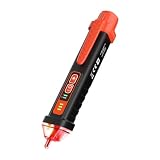
- Non-Contact AC Voltage Detector Pen: Check AC voltage without touching conductors. Supports high sensitivity 12-1000V and low sensitivity 48-1000V for wires, switches, socket holes, and basic AC electrical checks.
- Dual Sensitivity AC Checks: Select high or low sensitivity before detection. High sensitivity is for about 12-1000V AC, while low sensitivity is for about 48-1000V AC. Avoid switching sensitivity during detection.
- Live/Neutral Wire Identification: Compare the signal strength near two wires or between socket holes. A stronger signal indicates the live wire; a weaker or no signal indicates the neutral wire in this comparison method. No alarm alone does not confirm the absence of voltage.
- Audible and Visual Alarm: When AC voltage is detected, the electric tester pen beeps and lights 1-3 signal indicators by signal strength. Faster beeps and more lights indicate a stronger or closer AC voltage source.
- CAT Rated Safety for AC Checks: CAT III 1000V/CAT IV 600V rated with ABS housing, low-battery alert, LED flashlight, auto shutoff, and pocket clip. For AC voltage checks only; test on a known live source before use.

- SAFETY FIRST: It will send out multiple alarms through sound and light. When the voltage is detected, the tip will send out red light and beep. When the higher the sensed voltage is, or the closer it is to the voltage source, it beeps at a higher frequency and the percentage value will be larger. At the same time, the screen will be red or green, red means high voltage and live wire are detected, green means low voltage and null wire are detected
- NON-CONTACT: With NCV inductive probe for AC voltage; Just place the tip near a terminal strip, outlet, or supply cord. When the tip glows red and the pen beeps, you know there's voltage present. The live wire detector can automatically detect the live or neutral wire. Ideal for breakpoint Test. Handy circuit tester for electricians, homeowners
- DUAL RANGE: Detects standard and low voltage (12-1000V AC / 70-1000V AC) for more sensitive and flexible measurements. Press the S button to adjust sensitivity and adapt low range for doorbells, thermostats, irrigation wiring etc.; The NCV sensor automatically recognizes the voltage and displays it on the bar graph, and the percentage value can display the voltage signal intensity more intuitively
- SECURITY LEVEL: IEC rated CAT III 1000V CAT IV 600V, Meets CE requirements; The electrical tester is safely double insulated. High Voltage Alert to warn you of voltage above 90V, the screen turn red and the safety symbol on the screen shines
- COMPACT DESIGN: Bright LED flashlight for work in dim ares; Low-Power-Indicator when battery voltage is below 2.5V; Automatic Power Off after 5 minutes without operation or signal detection; Pocket-sized, pen hook allows you to carry it in your shirt pocket. We provide 36-Month after sale service, Please feel free to contact us if you have any concerns

- Voltbeat technology and continuous self test so you always know it is working
- Upon detection, tip glows
- Non-contact voltage detection from 90 to 1000 V ac
- Battery Check' ensures battery is in good condition
- Suitable for a wide range of residential, commercial and industrial needs
Choosing Your Non-Contact Voltage Tester: A Buyer’s Guide
A non-contact voltage tester (NCVT) is a simple, yet crucial tool. It lets you check if electricity is flowing in a wire or outlet without actually touching bare wires. This keeps you much safer! Before you buy one, you need to know what makes a good tester.
Key Features to Look For
What makes one NCVT better than another? Look for these important features:
- **Voltage Range:** This tells you what level of electricity the tester can detect. Most home testers cover 90V to 1000V AC. Make sure it covers the voltages you work with most often.
- **Sensitivity/Dual Sensitivity:** Better testers let you switch between high and low sensitivity. Low sensitivity checks main service panels. High sensitivity helps you find a single hot wire inside a bundle of cables.
- **Visual and Audible Alerts:** A good tester screams (beeps) and flashes a bright light when it finds voltage. This is essential if you work in noisy environments or dark places.
- **Battery Check/Indicator:** You do not want your safety tool to fail because of a dead battery. Always choose a model with a clear battery life indicator.
- **Safety Rating (CAT Rating):** Look for a CAT rating (like CAT II or CAT III). This shows the tester’s ability to handle electrical spikes safely. Higher CAT ratings mean better protection.
Important Materials and Build Quality
The material of the tester affects how long it lasts and how safe it is to use.
Most high-quality testers use durable, impact-resistant plastic for the casing. This plastic protects the delicate electronics inside if you drop the tool.
Durability Factors
A rugged build quality directly improves the tool’s lifespan. Look for testers with:
- **Rubber Grips:** These grips prevent the tester from slipping out of your hand, especially when your hands are sweaty or oily.
- **Durable Tip:** The sensing tip needs to be strong because you often press it against plastic outlet covers or insulation. Cheap plastic tips crack easily.
- **Water/Dust Resistance:** While most aren’t fully waterproof, some models offer basic ingress protection (IP ratings) against dust and splashes, which is a bonus for job sites.
A flimsy, lightweight tester often means lower-quality internal components. Better testers feel solid and balanced in your hand.
User Experience and Common Use Cases
A great NCVT must be easy to use, even for beginners. The goal is speed and certainty.
Ease of Use
If the tester requires complicated setup or calibration, you might skip using it when you are in a hurry. The best testers turn on instantly (or use an auto-off feature to save battery) and give immediate feedback.
Where You Will Use It
People use these testers in many situations:
- **Checking Outlets:** Quickly verify if an outlet is “hot” before plugging something in or testing it with a multimeter.
- **Identifying Wires:** When tracing wires in a wall or ceiling, you can use the high-sensitivity mode to pinpoint exactly where the live wire runs.
- **Troubleshooting Switches:** Confirming if power is reaching a light switch or a circuit breaker before replacing components.
- **Safety Verification:** Always use the tester on a known live source *before* you test the unknown wire. This confirms your tool is working correctly (a process called “live-dead-live” testing).
If a tester frequently gives false positives (beeps when there is no power) or false negatives (stays silent when power is present), its quality is poor, and it reduces your confidence significantly.
10 Frequently Asked Questions (FAQ) About Non-Contact Voltage Testers
Q: What is the main difference between an NCVT and a multimeter?
A: An NCVT only tells you if voltage is present (Yes/No). A multimeter measures the exact voltage level, current, and resistance. NCVTs are for fast safety checks; multimeters are for detailed diagnostics.
Q: Do I need batteries for a non-contact voltage tester?
A: Yes, almost all modern NCVTs require batteries (usually AAA or coin cell batteries) to power the sensor and the indicator lights/beepers.
Q: Can an NCVT detect DC voltage (like from a car battery)?
A: No. Standard NCVTs are designed only to detect Alternating Current (AC) voltage, which is what flows in household wiring.
Q: What does the CAT rating mean on a tester?
A: The CAT rating (Category Rating) tells you the maximum transient voltage spike the tester can safely handle. CAT III is generally recommended for standard residential and commercial building wiring.
Q: Why is my NCVT beeping when I test an outlet that seems dead?
A: This could be “phantom voltage.” This is a small, harmless voltage induced in nearby wires, especially if the tester is very sensitive or the wire is long. Always verify with a multimeter if you suspect an issue.
Q: How do I know if my NCVT is working correctly before using it?
A: You perform a “live-dead-live” test. First, test the NCVT on a known live source (like a working wall outlet). If it beeps, it works. Then, test the wire you are concerned about. Finally, test the known live source again to ensure it still works.
Q: Should I buy a model with a built-in flashlight?
A: Yes, this is highly recommended. Electrical work often happens in dark closets, basements, or breaker boxes. A built-in light adds significant utility.
Q: How close do I need to hold the tip to the wire?
A: This varies by model, but generally, you need to hold the tip within half an inch to an inch of the insulation to get a reliable reading.
Q: If the plastic casing is thick, does that make it safer?
A: Yes, the insulation quality of the casing is part of the safety rating. Thicker, high-quality plastic provides better insulation against accidental contact with live conductors.
Q: Is it okay to leave the NCVT turned on all the time?
A: No. Most modern testers have auto-off features. If yours does not, turn it off manually to save the battery life.

Hi, I’m Larry Fish, the mind behind MyGrinderGuide.com.. With a passion for all things kitchen appliances, I created this blog to share my hands-on experience and expert knowledge. Whether it’s helping you choose the right tools for your culinary adventures or offering tips to make your kitchen more efficient, I’m here to guide you. My goal is to make your time in the kitchen not only easier but also enjoyable! Welcome to my world of kitchen mastery!