
As an Amazon Associate I earn from qualifying purchases.
A weak or missing Wi-Fi connection can make your laptop frustrating to use, especially when its built-in wireless hardware is outdated or damaged. A USB adapter offers a simple fix, while an internal card can provide a more substantial upgrade if your laptop supports it.
Pay attention to connection type, wireless bands, advertised speed, operating-system support, and physical size. Dual-band models can use 2.4GHz or 5GHz networks, while a nano adapter is easier to leave plugged in during travel.
These five picks cover different laptop needs, from a high-speed internal Wi-Fi 6E module to straightforward 2.4GHz USB connectivity. They were selected from the listed features, compatibility information, antenna designs, and extra functions such as Bluetooth or access-point mode.
This guide compares each adapter’s main strength, explains who should consider it, and highlights the trade-offs you should check before ordering.
Our Top 5 Wireless Internet Card For Laptop Picks at a Glance
| Product | ||
|---|---|---|
 |
OKN AX210 Wi-Fi 6E M.2 Laptop Card Fast internal laptop upgrades |
Check Price |
 |
Nineplus 1300Mbps Dual-Band USB Wi-Fi Adapter Long-range USB connectivity |
Check Price |
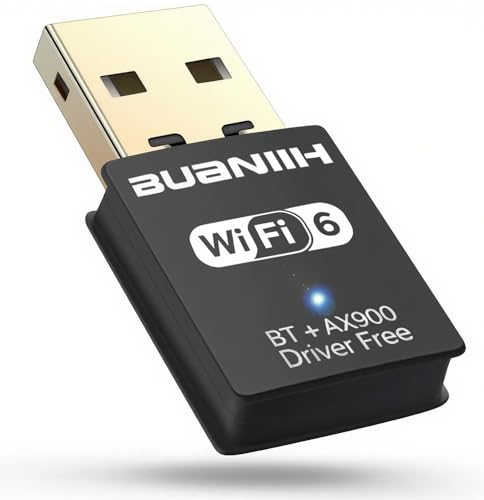 |
BUANIIH 600Mbps Wi-Fi and Bluetooth USB Adapter Wi-Fi and Bluetooth together |
Check Price |
 |
Cudy AC650 Nano USB Wi-Fi Adapter Compact everyday laptop use |
Check Price |
 |
LOTEKOO 300Mbps USB Wi-Fi Adapter Basic low-cost wireless access |
Check Price |
Top 5 Wireless Internet Card For Laptop: Detailed Picks
1. OKN AX210 Wi-Fi 6E M.2 Laptop Card
The OKN AX210 is a Wireless Internet Card For Laptop designed as an internal M.2 2230/NGFF upgrade. Its tri-band Wi-Fi 6E support adds the 6GHz band, while rated speeds reach 574Mbps on 2.4GHz and 2400Mbps on both 5GHz and 6GHz. In practice, 2.4GHz favors range, while 5GHz and 6GHz offer more bandwidth when your router supports them. MU-MIMO, OFDMA, 1024QAM, and 160MHz support help modern networks handle data efficiently. Bluetooth 5.3, WPA3, and Windows 10/11 64-bit support round it out.
What We Like:
- Tri-band Wi-Fi 6E adds access to the 6GHz band for compatible routers.
- The internal M.2 format makes it a tidy option for a supported laptop upgrade.
- Bluetooth 5.3 adds wireless device connectivity without a separate adapter.
- MU-MIMO, OFDMA, 1024QAM, and 160MHz support suit newer, busy networks.
- WPA3 support provides a current wireless security option.
What Could Be Improved:
- Installation is less convenient than using a USB adapter because you must open the laptop and have a compatible M.2 slot.
- Driver setup requires downloading the AX210 driver from Intel’s website.
- It supports Windows 10/11 64-bit with Intel CPUs and newer AMD CPUs, so older or different systems may not be compatible.
Buy it if you want a substantial internal upgrade with Wi-Fi 6E and Bluetooth 5.3, and your laptop supports the required M.2 module and operating system. Skip it if you prefer plug-and-play installation, use older hardware, or lack a compatible 6GHz router.
2. Nineplus 1300Mbps Dual-Band USB Wi-Fi Adapter
This Wireless Internet Card For Laptop is actually a Nineplus USB adapter designed to improve Wi-Fi on compatible Windows laptops and desktops. Its dual 5dBi antennas help strengthen reception and transmission, while dual-band support offers up to 867Mbps on 5GHz and 400Mbps on 2.4GHz. USB 3.0 provides faster data transfer than USB 2.0 and can support a more reliable connection. Most Windows 10 and 11 systems detect it automatically, making setup straightforward. The external antenna design favors range over the compactness of a small nano adapter.
What We Like:
- The two 5dBi antennas are built for stronger Wi-Fi reception and transmission.
- Dual-band support lets you use 5GHz for speed or 2.4GHz for broader coverage.
- USB 3.0 supports faster transfers than USB 2.0.
- It supports Windows 11, 10, 8.1, 8, 7, and XP.
- Most Windows 10 and 11 systems can install it without separate drivers.
What Could Be Improved:
- It does not support Mac OS, Chromebook, or Linux systems.
- The external antennas make it less convenient to carry than a nano USB adapter.
- The 1300Mbps figure combines the maximum listed speeds of both bands, rather than representing one connection speed.
Buy this Nineplus adapter if you use a compatible Windows laptop or desktop and want longer-range Wi-Fi with adjustable external antennas. It suits streaming, web use, gaming, and online meetings, provided your computer has USB 3.0. Skip it if you need Mac, Chromebook, Linux support, or a highly portable design.
3. BUANIIH 600Mbps Wi-Fi and Bluetooth USB Adapter
The BUANIIH USB adapter combines dual-band Wi-Fi, Bluetooth, and Windows access-point mode in one compact device. Its 2.4GHz band offers up to 150Mbps with better wall penetration, while 5.8GHz supports up to 433Mbps and can reduce interference. Windows 7–11 systems install it automatically in under 30 seconds, without a CD or separate drivers. In AP mode, an Ethernet-connected PC can share its connection with up to eight devices. Despite the Wireless Internet Card For Laptop label, its listed compatibility excludes macOS, Linux, and Windows XP.
What We Like:
- Dual-band Wi-Fi lets you choose range on 2.4GHz or lower interference on 5.8GHz.
- Built-in Bluetooth avoids needing a separate adapter for compatible peripherals.
- Windows 7–11 plug-and-play setup should be quick and simple.
- AP mode shares an Ethernet connection with up to eight devices.
- The compact USB design suits crowded desktop ports.
What Could Be Improved:
- It does not support macOS, Linux, or Windows XP.
- The listed 600Mbps total combines the two bands; the individual rates are 150Mbps and 433Mbps.
- AP mode is useful only with an Ethernet-connected PC, limiting its flexibility on laptops.
Buy it if you use a Windows 7–11 desktop and want Wi-Fi, Bluetooth, and basic hotspot sharing from one USB adapter. It also suits a Windows laptop with compatible ports. Skip it if you run macOS or Linux, need full-speed performance, or want a standalone travel hotspot.
4. Cudy AC650 Nano USB Wi-Fi Adapter
The Cudy AC650 Nano is a Wireless Internet Card For Laptop that adds dual-band Wi-Fi through a USB-A 2.0 port. It supports up to 433 Mbps on 5GHz and 200 Mbps on 2.4GHz, giving you a faster nearby connection or better flexibility for everyday browsing, streaming, and gaming. Its 20.75 × 15 × 7 mm, 2 g nano design can stay plugged in discreetly. Support covers Windows XP through 11, macOS 10.5–10.13, and Linux Kernel 4.19–5.x, though some systems require manual driver installation.
What We Like:
- The tiny 2 g design is easy to leave connected to a laptop.
- Dual-band support lets you choose faster 5GHz or more flexible 2.4GHz Wi-Fi.
- It works with a wide range of Windows, macOS, and Linux versions.
- MU-MIMO support can improve Wi-Fi efficiency with compatible routers.
- AP mode can turn a wired connection into a Wi-Fi hotspot.
What Could Be Improved:
- USB 2.0 and USB-A connectivity limit compatibility with newer USB-C-only laptops.
- Windows 7 and later install drivers automatically, but Windows XP, macOS, and Linux require manual installation.
- Its stated speeds are best suited to everyday use rather than demanding high-throughput networking.
Buy this adapter if you want a discreet, inexpensive way to add dual-band Wi-Fi to a USB-A laptop or desktop and value broad operating-system support. Skip it if your computer has only USB-C ports, you want the newest Wi-Fi standard, or you prefer automatic setup on every platform.
5. LOTEKOO 300Mbps USB Wi-Fi Adapter
The LOTEKOO 300Mbps USB WiFi Adapter is a basic 2.4GHz USB option for adding wireless access to a laptop, desktop, or PC. As a Wireless Internet Card For Laptop, it uses IEEE 802.11n/g/b standards and an internal omni-directional antenna, which helps keep the compact dongle easy to carry while supporting coverage and stability. Windows 10 and 11 offer plug-and-play setup, while older Windows versions, Linux, and some Mac OS versions are supported with drivers. Its 300Mbps figure describes the wireless transmission rate, not guaranteed internet speed.
What We Like:
- 2.4GHz support works with a wide range of legacy wireless networks.
- The internal antenna keeps the adapter compact without an external protrusion.
- Windows 10 and 11 support plug-and-play setup without driver installation.
- Compatibility includes Windows XP through Windows 11, Linux, and Mac OS 10.4-10.8.
- The included driver CD helps with supported systems that need manual setup.
What Could Be Improved:
- It supports only 2.4GHz, so it lacks the potentially less congested 5GHz band.
- Mac OS 10.9 through 10.15 are not supported.
- It does not work with televisions or other TV devices.
Choose the LOTEKOO if you need straightforward 2.4GHz wireless access, broad support for older Windows computers, and a small USB adapter. Skip it if you need 5GHz connectivity, use an unsupported Mac OS version, or want an adapter for a television.
How to Choose a Wireless Internet Card For Laptop
Check compatibility before speed
The right Wireless Internet Card For Laptop must fit your computer, not just promise a high connection rate. Internal cards require an available compatible slot, suitable antennas, and access to the laptop’s chassis, while USB adapters need a free port and enough clearance for their design.
Also confirm operating-system support and whether the adapter needs separate drivers. If you cannot identify your laptop’s existing card or opening the case feels risky, a USB model is usually the simpler route.
Match the adapter to your network
Choose a wireless standard that your router can use. A newer card may offer better potential performance and access to newer network bands, but it will not create those benefits if your router supports only older Wi-Fi. Dual-band models can give you more flexibility: the lower band generally travels farther, while the higher band can be preferable in a less congested area at shorter distances.
Do not judge the purchase by the advertised maximum alone. Your actual connection depends on the router, internet service, walls, interference, distance, and the laptop’s own hardware.
Decide between internal and USB
An internal upgrade keeps the adapter inside the laptop and can make sense when you want a tidier permanent setup. It may involve opening the computer and dealing with compatibility or antenna placement. A USB adapter is easier to move between computers and replace, but it can occupy a port and may be easier to bump or obstruct.
For travel, a compact design is convenient. For a laptop used at a desk or in a distant room, a larger USB adapter may be easier to position for a steadier signal, depending on its design.
Consider Bluetooth and everyday convenience
If you use wireless headphones, keyboards, mice, or controllers, Bluetooth support can reduce the need for a separate accessory. Treat it as a useful extra rather than a reason to ignore Wi-Fi compatibility.
Finally, check the return policy and installation instructions before buying. The safest choice is the model that fits your laptop, router, ports, and comfort level, rather than the one with the biggest number on the box.
Which Wireless Internet Card For Laptop Fits You?
The OKN AX210 Wi-Fi 6E M.2 Laptop Card is the best overall pick for a compatible laptop because it targets a faster internal upgrade without adding a USB device. The Nineplus 1300Mbps Dual-Band USB Wi-Fi Adapter is the best alternative if you want simpler installation and long-range USB connectivity. Choose the first for a permanent upgrade, or the second for flexibility across laptops.

Hi, I’m Larry Fish, the mind behind MyGrinderGuide.com.. With a passion for all things kitchen appliances, I created this blog to share my hands-on experience and expert knowledge. Whether it’s helping you choose the right tools for your culinary adventures or offering tips to make your kitchen more efficient, I’m here to guide you. My goal is to make your time in the kitchen not only easier but also enjoyable! Welcome to my world of kitchen mastery!