
As an Amazon Associate I earn from qualifying purchases.
An Ir Thermometer helps you check surface temperatures without touching hot, moving, or hard-to-reach objects. The challenge is choosing a model that suits your working distance, target size, and temperature range.
Pay attention to distance-to-spot ratio, emissivity control, laser targeting, and measurement modes. A probe can also matter if you need internal food temperatures rather than surface readings.
These five picks were selected from the listed features, with options for industrial monitoring, general maintenance, cooking, grilling, and simpler everyday checks. They also differ in targeting systems, measurement range, and added functions.
This guide compares each model’s strongest use case, then explains the specifications that should influence your choice.
Our Top 5 Ir Thermometer Picks at a Glance
| Product | ||
|---|---|---|
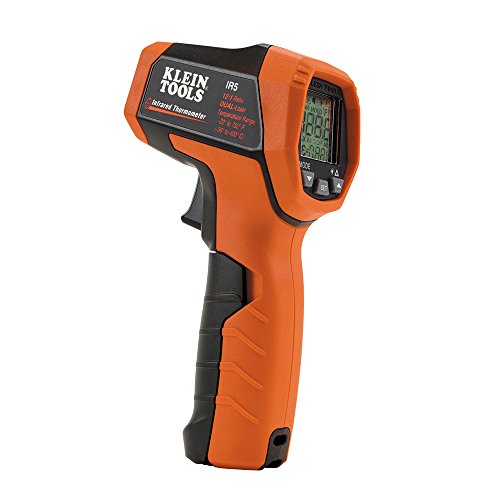 |
Klein Tools IR5 Infrared Thermometer Versatile professional temperature checks |
Check Price |
 |
Fluke 62 MAX Industrial IR Thermometer Industrial environments |
Check Price |
 |
Etekcity Lasergrip 774 Infrared Thermometer Cooking and home maintenance |
Check Price |
 |
TempPro TempScan 2-in-1 Thermometer Grilling and food preparation |
Check Price |
 |
Soonkoda Digital Infrared Thermometer Simple wide-range checks |
Check Price |
Top 5 IR Thermometers: Detailed Reviews
1. Klein Tools IR5 Infrared Thermometer
The Klein Tools IR5 is an Ir Thermometer for non-contact checks across cooking, HVAC, and general maintenance. Its -22°F to 752°F (-30°C to 400°C) range covers both cold and high-temperature jobs, while the 12:1 distance-to-spot ratio helps you measure smaller areas from farther away. Dual targeting lasers show the measurement area clearly. Adjustable emissivity from 0.1 to 1.0 helps account for different surface materials, and auto scan, maximum, minimum, average, difference, and high/low alarm modes give you useful ways to interpret readings.
What We Like:
- The dual lasers make it easier to aim at the intended surface area.
- The 12:1 ratio supports readings from a practical distance.
- Adjustable emissivity improves flexibility across different materials.
- The max, min, average, and difference modes help track temperature variation.
- The backlit display and auto power-off suit routine field use.
What Could Be Improved:
- The range of modes and adjustable emissivity may take some time to learn.
- It is not intended for measuring people or animals, so it cannot replace a medical thermometer.
- Its broad professional feature set may be more than you need for occasional household checks.
Buy this if you need one versatile IR Thermometer for HVAC work, equipment checks, cooking surfaces, and other non-contact measurements. The dual lasers, broad range, and adjustable emissivity give you more control than a basic model. Skip it if you only need occasional simple readings or a device for body temperature.
2. Fluke 62 MAX Industrial IR Thermometer
The Fluke 62 MAX Industrial Ir Thermometer is built for non-contact surface temperature checks in electrical, mechanical, HVAC, and automotive systems. Its broad -22°F to 932°F range covers cold equipment and high-temperature components, while the 10:1 distance-to-spot ratio lets you measure a smaller area from farther away. Single-laser targeting helps you aim consistently. You can also view minimum, maximum, difference, and average readings. The IP54 rating adds protection against dust and splashing liquid, though this is strictly an industrial instrument, not a human thermometer.
What We Like:
- The broad temperature range suits demanding industrial inspections.
- A 10:1 distance-to-spot ratio helps target smaller areas from a safer distance.
- Laser sighting makes it easier to identify the measurement area.
- Minimum, maximum, difference, and average readings support comparison work.
- IP54 protection helps it handle dusty areas and splashing liquid.
What Could Be Improved:
- It is not suitable for measuring human body temperature.
- The single laser provides targeting assistance, but not multiple-point targeting.
- Its accuracy specification is less reassuring at the extremes, with stated accuracy of ±1.5°C or ±1.5% of the reading from 0°C to 500°C.
Buy this if you need an industrial-focused thermometer for electrical, mechanical, HVAC, or automotive checks and value a wide range, laser targeting, and environmental protection. Skip it for cooking, household-only tasks, or body-temperature readings, since Fluke specifies it for industrial use only and not for human use.
3. Etekcity Lasergrip 774 Infrared Thermometer
The Etekcity Lasergrip 774 is an Ir Thermometer for checking surface temperatures across cooking, home maintenance, and automotive tasks. Its 12:1 distance-to-spot ratio lets you measure from farther away while targeting a smaller area, which suits pizza ovens, BBQ grates, HVAC components, and engines. Adjustable emissivity helps you account for different surface types. The -58° to 842°F (-50° to 450°C) range covers ordinary household and high-heat jobs. A large backlit LCD improves readability, and the trigger-based design keeps operation straightforward.
What We Like:
- The 12:1 ratio makes safer measurements around hot surfaces easier.
- Adjustable emissivity adds useful flexibility for different materials.
- The wide temperature range suits cooking, HVAC, and engine checks.
- The backlit LCD remains easier to read in dim areas.
- The trigger-style operation is simple for quick readings.
What Could Be Improved:
- It measures surface temperature, not the internal temperature of meat or other food.
- You need to understand emissivity settings to get the best results on different surfaces.
- A distance-to-spot ratio still requires careful positioning when measuring small targets.
Buy it if you want one accessible infrared gun for pizza ovens, grilling, HVAC checks, DIY jobs, and engine work. Skip it if you need internal food temperatures, highly specialized industrial measurement, or a tool that removes the need to understand surface emissivity.
4. TempPro TempScan 2-in-1 Thermometer
The TempPro TempScan 2-in-1 Ir Thermometer combines non-contact surface scanning with an instant-read probe for internal temperatures. Use its 12:1 distance-to-spot ratio and adjustable emissivity to check pans, griddles, pizza stones, oven walls, HVAC equipment, or automotive surfaces without touching them. Insert the probe for food temperatures, with readings in 2–3 seconds and stated precision of ±1.8°F. Motion sensing wakes it when you pick it up and sleeps when set down. A switchable °F/°C display, auto-off, low-battery indicator, magnet, and hanging hole make storage and daily use straightforward.
What We Like:
- One tool handles both hot surface checks and internal food temperatures.
- The 12:1 distance-to-spot ratio helps you scan surfaces without getting too close.
- Adjustable emissivity gives you better control across different surface materials.
- The probe provides internal readings in 2–3 seconds with stated ±1.8°F precision.
- Motion sensing, auto-off, and the built-in magnet make regular use more convenient.
What Could Be Improved:
- The IR mode measures surfaces only, so you must use the probe to check internal doneness.
- Adjustable emissivity is useful, but you need to select the right setting for meaningful surface readings.
- The probe takes 2–3 seconds, so “instant read” is not literally immediate.
Buy it if you grill, cook temperature-sensitive foods, or want one device for kitchen, HVAC, and DIY surface checks. The combination is practical, but skip it if you only need a basic surface scanner or probe, since switching modes and managing emissivity adds extra steps.
5. Soonkoda Digital Infrared Thermometer
The Soonkoda Digital Infrared Thermometer is a handheld, non-contact option for cooking, BBQs, pizza ovens, and general heat checks. Its -58°F to 932°F range covers very cold and high-temperature surfaces, while 0.1-degree resolution helps you spot smaller changes. You can switch between Celsius and Fahrenheit, use the LCD backlight in dark areas, and rely on data hold after releasing the trigger. The built-in automatic shutdown activates after about eight seconds, helping conserve power, though it may interrupt longer checks.
What We Like:
- The wide -58°F to 932°F range suits cooking and many household heat checks.
- The backlight makes readings easier to see at night or around dim ovens.
- Celsius and Fahrenheit conversion lets you use your preferred measurement system.
- Data hold keeps the last reading visible after you release the trigger.
- The 0.1-degree display resolution makes small temperature changes easier to read.
What Could Be Improved:
- The preset 0.95 emissivity can produce inaccurate readings on shiny or polished metal.
- The roughly eight-second automatic shutdown may be inconvenient during extended inspections.
- It measures surface temperature, so readings may not represent the temperature inside food or other materials.
Buy this Soonkoda if you want a simple, wide-range Ir Thermometer for grilling, pizza ovens, cooking, and routine home checks. It offers useful visibility and basic measurement controls without added complexity. Skip it if you regularly measure shiny or polished metal, need longer continuous operation, or require internal temperature readings.
How To Choose An IR Thermometer
What to look for in an Ir Thermometer
Choose an Ir Thermometer based on the jobs you expect it to handle, not simply its advertised temperature range. Cooking, HVAC checks, vehicle work and industrial inspections can require different levels of reach, accuracy and durability. Start by listing your usual tasks, then compare each model against those needs.
Temperature range and measurement distance
A wide temperature range gives you more flexibility, but it matters only if the thermometer remains suitable for your intended work. For cooking, you may focus on useful readings around food, grills and cooking surfaces. HVAC and industrial tasks can involve hotter or colder components, so check that the stated range covers your applications.
Also consider the distance-to-spot ratio. This determines how far away you can stand while still measuring a reasonably specific area. A model with a suitable ratio is easier to use on vents, pipes or hot surfaces where getting close may be inconvenient or unsafe.
Accuracy, controls and readability
Look for clear controls and a display you can read quickly while working. Backlighting can help in dim spaces, while a simple trigger and straightforward settings reduce handling time. If you need to compare several surfaces, features such as stored readings, maximum or minimum values, and adjustable emissivity can make the process more useful, provided the thermometer includes them.
Surface type also affects infrared readings. Shiny or reflective materials can be more difficult to measure consistently, so check whether the model offers guidance or settings for different surfaces. Do not assume a very precise display guarantees equally precise results in every situation.
Build quality, safety and practical use
For occasional home checks, compact size and simple operation may matter most. Frequent HVAC or industrial work places greater value on a rugged build, dependable controls and protection suited to the environment. Consider whether you will carry it in a toolbox, use it near heat, or handle it with gloves.
A laser pointer can help you aim, but it does not measure the entire visible area or remove the need to position the thermometer correctly. Check the operating instructions, avoid aiming at people or reflective surfaces, and choose a model whose controls and construction match your working conditions.
Which IR Thermometer Should You Choose?
The Klein Tools IR5 Infrared Thermometer is the best overall pick because it is positioned for versatile, professional temperature checks, making it the broadest fit for cooking and HVAC-related work. The Etekcity Lasergrip 774 is the best alternative if your priorities centre on cooking and home maintenance rather than more professional use. Choose the Fluke 62 MAX instead when industrial environments are your main concern.

Hi, I’m Larry Fish, the mind behind MyGrinderGuide.com.. With a passion for all things kitchen appliances, I created this blog to share my hands-on experience and expert knowledge. Whether it’s helping you choose the right tools for your culinary adventures or offering tips to make your kitchen more efficient, I’m here to guide you. My goal is to make your time in the kitchen not only easier but also enjoyable! Welcome to my world of kitchen mastery!