
As an Amazon Associate I earn from qualifying purchases.
Picking the right Raspberry Pi Camera means balancing resolution, low-light performance, and compatibility with your board. Some projects need sharp stills, others require AI processing or night vision.
We selected five distinct models that cover different budgets and use cases, from basic 1080p modules to advanced AI-powered sensors. Each excels in a specific scenario, so you can match the camera to your project.
This guide explains what each camera does best, its limitations, and who it suits. No fluff, just the details you need to decide.
Our Top 5 Raspberry Pi Camera Picks at a Glance
| Product | ||
|---|---|---|
 |
Raspberry Pi AI Camera with IMX500 Sensor AI and machine vision |
Check Price |
 |
Arducam IMX477 HQ Camera with CS Lens High-resolution photography |
Check Price |
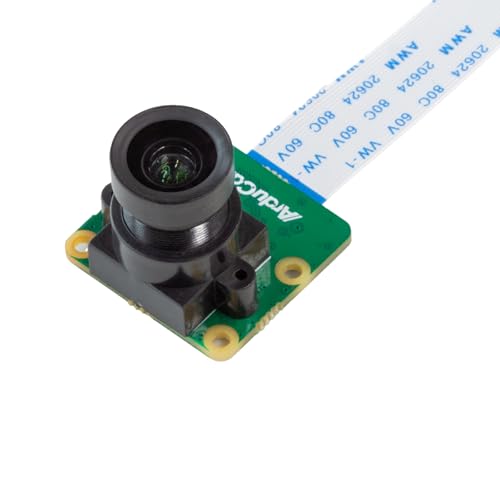 |
Arducam 4K IMX415 Low Light Camera Low-light and night use |
Check Price |
 |
Arducam Day-Night Vision Camera with IR 24/7 surveillance |
Check Price |
 |
Arducam 8MP IMX219 Camera Module V2 Budget-friendly 1080p |
Check Price |
Top 5 Raspberry Pi Cameras: Detailed Reviews
1. Raspberry Pi AI Camera with IMX500 Sensor
The Raspberry Pi AI Camera packs a 12.3 MP Sony IMX500 sensor with a built-in neural network accelerator, letting you run real-time object detection without extra hardware. The integrated RP2040 chip handles firmware and inference, while the pre-loaded MobileNet model gets you started fast. It captures 4K stills at 10fps or 1080p at 30fps, with a 76-degree field of view for wide coverage.
What We Like:
- Built-in AI means no extra compute module for basic vision tasks
- RP2040 offloads processing to keep the main Pi free
- MobileNet model works out of the box for quick prototyping
- Decent resolution and frame rates for most DIY projects
- Compact design fits standard Pi camera mounts
What Could Be Improved:
- Limited to pre-loaded models without extra configuration
- 10fps at full resolution may be slow for fast-moving subjects
This is ideal if you need plug-and-play AI vision for robotics or smart home projects. Skip it if you require higher frame rates or custom model support beyond the basics.
2. Arducam IMX477 HQ Camera with CS Lens
The Arducam IMX477 Pi HQ Camera is a high-resolution Raspberry Pi Camera with a 12.3MP sensor and interchangeable CS-mount lens, delivering sharp 4056×3040 stills. The included 6mm CS lens offers manual focus and adjustable aperture, giving you control over depth of field and clarity. Setup is straightforward with included cables for Raspberry Pi 5, 4B, 3B+, and Zero models, making it versatile for most DIY projects.
What We Like:
- 12.3MP sensor captures detailed, high-resolution images
- Interchangeable CS-mount lens allows for customization
- Manual focus and adjustable aperture for precise control
- Includes cables for easy setup with multiple Raspberry Pi models
- Wide compatibility with most Raspberry Pi boards
What Could Be Improved:
- Requires manual configuration for Raspberry Pi 5 cam0 port
- No built-in autofocus may limit ease of use for beginners
This Raspberry Pi Camera suits photographers and DIY builders who need high resolution and lens flexibility. Skip it if you want plug-and-play simplicity or autofocus.
3. Arducam 4K IMX415 Low Light Camera
The Arducam 4K IMX415 Low Light Camera Module pairs a STARVIS sensor with an M12 lens to capture sharp 8.3MP images in dim conditions. The 3840×2160 resolution and 1.45µm pixels deliver fine detail, while the built-in IR cut filter ensures natural colors. It works with Raspberry Pi 5, 4B, 3B+, and Zero, and includes a 15-15pin or 15-22pin ribbon cable for easy setup. Requires a recent Raspberry Pi OS and kernel version for full compatibility.
What We Like:
- 8.3MP resolution provides crisp 4K images for detailed shots
- STARVIS sensor excels in low-light environments without excessive noise
- M12 lens is pre-tuned for the sensor, reducing setup hassle
- Includes IR cut filter for accurate color reproduction
- Open-source drivers ensure broad compatibility with Raspberry Pi models
What Could Be Improved:
- Requires specific OS and kernel versions, which may limit use on older systems
- M12 lens may need manual adjustment for some applications
This Raspberry Pi Camera suits photographers and DIY builders needing high resolution in low light. Skip it if you lack the technical patience for driver setup or need plug-and-play simplicity.
4. Arducam Day-Night Vision Camera with IR
The Arducam Day-Night Vision Raspberry Pi Camera delivers clear images around the clock with its automatic IR-cut filter, which prevents the pink or washed-out effect common in low-light shots. The built-in IR LED illuminator enhances visibility at night, while the IR-corrected lens maintains focus. It works seamlessly with all Raspberry Pi models and supports standard Raspicam commands, making it ideal for security, surveillance, or time-lapse projects.
What We Like:
- Automatic IR-cut switching ensures natural colors day and night
- IR LED illuminator improves low-light performance without extra hardware
- Compatible with all Raspberry Pi models and standard software
- Includes heat sinks and a ribbon cable for Pi Zero
- Reduces focus shift in night conditions
What Could Be Improved:
- IR LED range is limited in complete darkness
- Requires additional cooling for prolonged use
This is a solid choice if you need reliable day-night vision for security or monitoring projects. Skip it if you require long-range night visibility or a plug-and-play solution without tweaking.
5. Arducam 8MP IMX219 Camera Module V2
The Arducam 8MP IMX219 is a plug-and-play Raspberry Pi Camera module that delivers 1080p video and stills up to 3280 x 2464 pixels. It includes a 15cm FFC cable for standard Pi models and a 15cm FPC cable for Pi Zero, making it versatile for most setups. Frame rates reach 47fps at 1080p, suitable for smooth monitoring or time-lapse work. Power requirements are modest, needing just 5V at 1.8A.
What We Like:
- Sharp 8MP sensor captures detailed images for general use
- Includes cables for both standard and Zero Raspberry Pi models
- High frame rates at 1080p for smooth video
- Low power draw fits most DIY projects
- Compact and lightweight for easy mounting
What Could Be Improved:
- Fixed-focus lens limits close-up clarity
- No IR or low-light optimisation for night use
This is a solid choice if you need a simple, reliable Raspberry Pi Camera for everyday projects like 3D printer monitoring or basic surveillance. Skip it if you require low-light performance or adjustable focus.
How to Choose the Right Raspberry Pi Camera
Start with the use case. A Raspberry Pi Camera for machine vision needs AI capabilities, while photography demands high resolution and manual focus. If you’re shooting in dim light, prioritise low-light sensors or IR support for night vision.
Check compatibility. Not all modules work with every Raspberry Pi model, so verify the interface and software support before buying. Some cameras require additional libraries or tweaks to function properly.
Resolution and sensor quality
Higher resolution doesn’t always mean better results. A 8MP sensor with good low-light performance may outperform a 12MP one in poor conditions. Balance megapixels with sensor size and sensitivity for your needs.
Lens and focus options
Fixed-focus lenses are simple but limit flexibility. Interchangeable lenses let you adapt to different scenes, but they add cost and complexity. For surveillance or macro work, manual focus control can be essential.
Connectivity and ease of use
Most Raspberry Pi Camera modules use the CSI interface, but some third-party options rely on USB. CSI is faster and more reliable for real-time applications, while USB offers broader compatibility with non-Pi devices.
Which Raspberry Pi Camera Fits Your Project
The Raspberry Pi AI Camera with IMX500 Sensor is the best overall pick for its versatility in AI and machine vision tasks. If you need high-resolution stills, the Arducam IMX477 HQ Camera with CS Lens is the strongest alternative, offering professional-grade image quality.

Hi, I’m Larry Fish, the mind behind MyGrinderGuide.com.. With a passion for all things kitchen appliances, I created this blog to share my hands-on experience and expert knowledge. Whether it’s helping you choose the right tools for your culinary adventures or offering tips to make your kitchen more efficient, I’m here to guide you. My goal is to make your time in the kitchen not only easier but also enjoyable! Welcome to my world of kitchen mastery!