
As an Amazon Associate I earn from qualifying purchases.
Finding a Science Subscription Box that keeps a child interested can be difficult when kits vary widely in subject, age range and experiment count. These products are activity kits rather than recurring deliveries, so check the format if you specifically want a monthly subscription.
Look for clear instructions, useful tools and experiments that match your child’s interests. Chemistry kits suit reaction fans, while electronics and engineering sets offer more building and problem-solving.
These picks were selected from the listed features, prioritising variety, experiment range, guidance and distinct learning styles. They also cover several age groups and types of hands-on science.
The guide starts with the strongest all-rounder, then covers electronics, earth science, chemistry and open-ended invention. Each review explains who will get the most from the kit and what sets it apart.
Our Top 5 Science Subscription Box Picks at a Glance
| Product | ||
|---|---|---|
 |
ZDRKWSM 220+ Science Lab Experiment Kit Broadest experiment variety |
Check Price |
 |
Science Kidz Electronics Experiment Kit Learning circuits hands-on |
Check Price |
 |
Blue Marble National Geographic Earth Science Kit Earth science exploration |
Check Price |
 |
Discovery Super Reactions Science Kit Chemistry and reactions |
Check Price |
 |
Tinkering Labs Inventors STEM Kit Open-ended engineering projects |
Check Price |
Top 5 Science Subscription Box Picks: Detailed Reviews
1. ZDRKWSM 220+ Science Lab Experiment Kit
The ZDRKWSM Science Kit is a Science Subscription Box-style experiment set offering more than 220 guided activities across a wide range of topics. You can explore volcanic eruptions, rainbow rain, rainbow fountains and bottle-blowing balloons using the 47-piece kit, which includes goggles, beakers, test tubes and a flask. The easy-to-follow manual explains both the steps and the scientific principles, moving from simpler activities to more challenging ones. Packaged bottles are designed for easy use and storage, while the group-friendly format makes experiments suitable for sharing with family, friends or classmates.
What We Like:
- More than 220 experiments provide exceptional variety for repeated play.
- The manual connects each activity with its scientific principles.
- Included goggles, beakers, test tubes and a flask make the kit feel like a real lab.
- The progression from simple to challenging activities can build confidence.
- Experiments such as eruptions and rainbow fountains offer visually engaging results.
What Could Be Improved:
- The broad selection may make it harder to choose which experiment to start with.
- A 47-piece kit covering many topics is less focused than a specialist chemistry or electronics set.
- Children seeking open-ended invention may prefer a kit with fewer instructions and more building projects.
Buy it if you want the broadest experiment variety in this group and your child enjoys following clear instructions across different science topics. It also suits shared family or classroom activities. Skip it if your child prefers focused electronics, earth science or open-ended engineering projects.
2. Science Kidz Electronics Experiment Kit
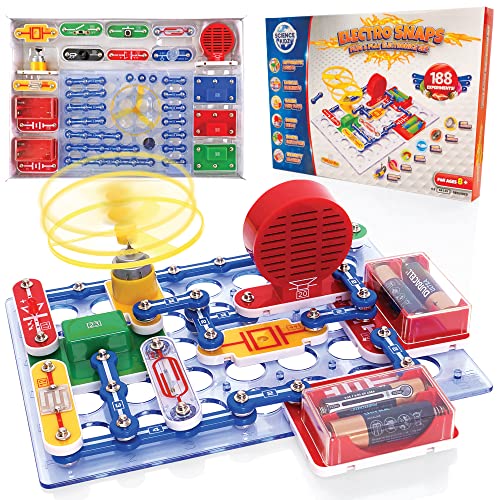
The Science Kidz Electronics Kit is a Science Subscription Box pick for ages 5-10 that focuses on building real circuits with snap-together parts. It offers more than 188 projects, including a Flying UFO, sound effects and light shows, so children can explore electronics through hands-on builds. The parts are designed to be simple, child safe and usable without extra tools. A detailed, illustrated colour manual supplies step-by-step instructions and educational points, helping younger learners follow each project while connecting the activity to basic science concepts.
What We Like:
- Snap-together parts make circuit building approachable for younger children.
- More than 188 projects give kids plenty of experiments to explore.
- No extra tools are required, simplifying setup and cleanup.
- The illustrated colour manual makes instructions easier to follow.
- Child-safe components comply with USA and EU toy safety standards.
What Could Be Improved:
- Its electronics focus offers less subject variety than a broader science kit.
- The provided details do not say whether batteries are included, so check before gifting.
Buy it if your child is 5-10 and enjoys hands-on building, lights, sounds or simple electronics, especially with a clear manual to follow. Skip it if you want chemistry, earth science or open-ended engineering projects, or if you prefer a kit whose battery requirements are clearly stated.
3. Blue Marble National Geographic Earth Science Kit
The Blue Marble National Geographic Earth Science Kit is a Science Subscription Box-style activity set for kids ages 8–12, centered on crystals, volcanoes, rocks, and other Earth-focused discoveries. It includes more than 15 experiment activities, such as dueling water tornadoes, an erupting volcano, a crystal-growing project, and two geologic dig kits. The full-color Learning Guide explains the science behind each activity, while clear instructions help children work more independently. Its range of projects also makes it practical for sharing with siblings, friends, or classmates rather than treating it as a one-session kit.
What We Like:
- The Earth-science theme gives curious kids a clear, engaging focus.
- Crystal growing and geologic dig kits offer hands-on discovery.
- Volcano and tornado experiments add visible, memorable results.
- The full-color Learning Guide connects activities with real science.
- Multiple experiments make it suitable for small groups or siblings.
What Could Be Improved:
- Its Earth-focused activities may feel narrow to children more interested in electronics or engineering.
- The broad activity selection could feel less focused than a kit built around one science topic.
- Some projects may be better suited to shared sessions than quick solo activities.
Buy it for an 8–12-year-old who enjoys rocks, crystals, volcanoes, and learning through hands-on experiments. It suits families, classrooms, and playdates especially well. Skip it if your child wants open-ended building, circuit work, or a kit centered on chemistry rather than Earth science.
4. Discovery Super Reactions Science Kit
For a Science Subscription Box roundup, Discovery’s Super Reactions Science Kit stands out for chemistry-focused play. It includes 66 experiments: 26 guided activities and 40 bonus ideas using household items. Kids explore acid-base reactions, pH indicators, states of matter, gas expansion, slime, color changes, glowing potions, and volcanoes. The kit supplies test tubes, food coloring, citric acid, slime mix, popping crystals, and a volcano mold, so you can begin a home lab with the included materials. Clear instructions support independent learning, though adult supervision is required.
What We Like:
- The 26 guided activities give kids a clear starting point for hands-on chemistry.
- The volcano mold, glowing potions, blue lava, and slime keep abstract concepts tangible and engaging.
- The kit introduces acid-base reactions, pH, gas expansion, and states of matter through practical experiments.
- The 40 bonus DIY ideas extend play with common household items.
- Included tools and ingredients help you set up experiments without sourcing every component separately.
What Could Be Improved:
- Only 26 of the 66 experiments are step-by-step guided activities; the bonus ideas require household items and more preparation.
- Adult supervision is required, so it is not a fully independent activity kit for younger children.
- Its chemistry focus may feel limiting for kids who primarily want electronics, earth science, or open-ended engineering projects.
Buy it for curious kids aged 8 and up who enjoy colorful reactions, slime, volcanoes, and learning how chemistry works. Skip it if you want electronics or engineering projects, or if you need a kit that children can use without adult supervision and extra household supplies.
5. Tinkering Labs Inventors STEM Kit
This Science Subscription Box is an open-ended engineering kit for children ages 8-10. Tinkering Labs includes more than 50 parts, including laser-cut wood, motors, authentic hardware connectors, rubber bands and tools, so children can build machines rather than follow one fixed project. The included electricity circuits and robotics activities introduce practical engineering concepts, while teacher-developed guides provide direction. Durable, reusable parts support repeated inventions, and the screen-free format encourages hands-on problem-solving with room to add LEGO blocks and experiment with gravity.
What We Like:
- More than 50 parts give children plenty of ways to create unique machines.
- Motors and electricity circuits make engineering concepts tangible during play.
- Open-ended projects encourage problem-solving instead of copying a single design.
- Teacher-developed guides add structure without limiting creativity.
- Durable, reusable components support repeated inventions and experiments.
What Could Be Improved:
- The open-ended format may feel less satisfying to children who prefer clearly defined, step-by-step experiments.
- With many parts, tools and connectors, younger users may benefit from adult help getting started and keeping projects organised.
- This kit focuses on invention and engineering rather than covering a broad range of science topics.
Buy it for curious children ages 8-10 who enjoy building, tinkering and inventing their own machines, especially if you want a screen-free STEM activity. Skip it if your child prefers predictable experiments, finished models or lessons focused on chemistry, earth science or a wider mix of subjects.
How To Choose A Science Subscription Box
A Science Subscription Box should match your child’s interests, attention span, and willingness to work through a process rather than simply promise a large number of activities. Before buying, focus on what your child will actually do with the materials, how much help they may need, and whether the projects offer enough variety to stay interesting.
Match the subject to their curiosity
Science covers a wide range of interests, from chemistry and reactions to electronics, earth science, and engineering. Choose a box that reflects what your child already asks about, or select a broader kit if they are still exploring. A focused subject can make learning more coherent, while a varied collection gives them more chances to find a favourite area.
Check the type of learning involved
Look at whether the projects ask children to follow instructions, build a working system, observe changes, or design their own solution. Guided experiments can help beginners feel successful, while open-ended projects suit children who enjoy making choices and solving problems. The best fit depends on whether your child prefers clear steps or room to tinker.
Consider the amount of adult support
Some activities are easier for children to complete independently, while others may require an adult to explain a concept, organise materials, or help troubleshoot. Read the activity descriptions carefully and think about when your child will use the kit. A project that needs regular assistance may work well as a shared weekend activity but be less suitable for independent play.
Assess variety and lasting value
Count more than the number of activities. Consider whether the projects repeat the same basic idea or introduce genuinely different concepts. A kit with broad variety can remain useful for longer, while a specialised box may offer deeper practice in one area. Also check what the package includes and whether any additional household items, replacement components, or preparation could affect how easily you use it.
Which Science Subscription Box Should You Choose?
The ZDRKWSM 220+ Science Lab Experiment Kit is the best overall pick because it offers the broadest experiment variety, giving curious kids plenty of directions to explore. The Science Kidz Electronics Experiment Kit is the best alternative if your child is especially interested in circuits and prefers hands-on electrical projects. Choose between them based on whether you value wide-ranging discovery or a more focused electronics learning path.

Hi, I’m Larry Fish, the mind behind MyGrinderGuide.com.. With a passion for all things kitchen appliances, I created this blog to share my hands-on experience and expert knowledge. Whether it’s helping you choose the right tools for your culinary adventures or offering tips to make your kitchen more efficient, I’m here to guide you. My goal is to make your time in the kitchen not only easier but also enjoyable! Welcome to my world of kitchen mastery!