
As an Amazon Associate I earn from qualifying purchases.
Finding an Under 1000 3D Printer means balancing ease of use, print speed, build space, and the kind of materials or projects you want to make. A beginner-friendly mini printer suits simple models, while an enclosed or multi-color machine offers more room to grow.
Pay attention to setup, automatic leveling, connectivity, filament support, and whether the printer includes features such as multi-color printing or a removable build plate. These details affect how much time you spend preparing prints and removing finished models.
These five picks cover distinct needs rather than repeating minor variants. The selection includes a high-speed enclosed printer, a multi-color CoreXY model, a compact beginner option, and a portable machine for smaller projects.
Use the short recommendations to narrow your options, then check the buying guide for the features that matter most to your workflow.
Our Top 5 Under 1000 3D Printer Picks at a Glance
| Product | ||
|---|---|---|
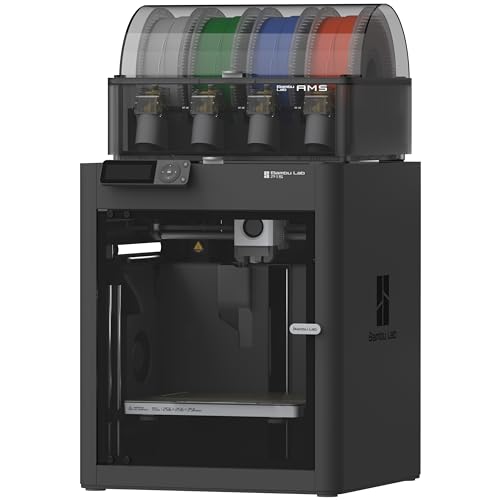 |
Bambu Lab P1S Combo Multi-color enclosed printing |
Check Price |
 |
FLASHFORGE AD5X Fast, larger multi-color prints |
Check Price |
 |
Bambu Lab A1 mini LED Kit Beginner creative projects |
Check Price |
 |
HEPHI3D TINA2C First-time home printing |
Check Price |
 |
Generic Portable 3D Printer Small-space, flexible-filament printing |
Check Price |
Top 5 Under 1000 3D Printer: Detailed Reviews
1. Bambu Lab P1S Combo
The Bambu Lab P1S Combo is an enclosed Under 1000 3D Printer that combines high-speed printing with the included AMS multi-color system. It can potentially use up to 16 colors, though connecting Bambu Lab AMS is required. Its 500mm/s speed and 20,000 mm/s² acceleration can shorten print times, while automatic bed leveling helps simplify setup. The enclosure supports materials including PLA, PETG, TPU, PVA, PET, ABS, and ASA, with PA and PC listed as capable options. Setup takes about 15 minutes.
What We Like:
- The enclosed design suits advanced filaments and helps contain the printing area.
- The included AMS enables multi-color and multi-material printing.
- Up to 16 colors gives you room for detailed, visually complex models.
- Automatic bed leveling reduces manual setup work.
- High speed and acceleration help you finish projects sooner.
What Could Be Improved:
- The full 16-color potential requires additional AMS units beyond the included system.
- Carbon- and glass-fiber-reinforced polymers are not recommended.
- PA and PC are listed as capable rather than ideal materials, so material choice is more limited than the broad filament list suggests.
Buy the P1S Combo if you want one capable machine for fast, enclosed printing and multi-color projects, especially if you already use PLA, PETG, TPU, or similar materials. Skip it if you only need basic single-color printing, plan to use carbon- or glass-fiber-reinforced filament, or do not need the added AMS flexibility.
2. FLASHFORGE AD5X
The FLASHFORGE AD5X is an Under 1000 3D Printer built for fast, colorful projects. Its CoreXY design reaches up to 600mm/s, while the 220 x 220 x 220mm build volume gives you useful room for medium-sized parts. Support for up to four colors enables multicolor prints, and 1-Click Auto Leveling reduces bed-calibration work. The 300°C direct-drive extruder handles varied printing needs, while vibration compensation, dual-channel cooling, automatic filament feeding, and power-loss resume support smoother operation.
What We Like:
- CoreXY motion supports very fast printing, with speeds up to 600mm/s.
- Four-color printing adds visual flexibility for models, signs, and creative projects.
- Automatic leveling reduces setup and helps maintain a consistent print surface.
- The 220mm cubed build area accommodates many everyday parts and models.
- A 300°C direct-drive extruder and four nozzle sizes support different printing goals.
What Could Be Improved:
- The 220 x 220 x 220mm build volume limits large one-piece prints.
- Four-color printing and the printer’s many automated features may be more complexity than a first-time user needs.
- High-speed printing can be unnecessary if your priority is simple, slower projects rather than productivity.
Buy the FLASHFORGE AD5X if you want fast CoreXY printing, a practical medium-sized build area, and multicolor capability in one machine. It suits creative makers and users producing several parts. Skip it if you only need basic small prints or prefer the simplest possible first printer.
3. Bambu Lab A1 mini LED Kit
The Bambu Lab A1 mini + LED Lamp Kit is a compact Under 1000 3D Printer pick for beginners who want a practical first project. Automatic calibration and simple setup reduce the manual preparation you need before printing. MakerWorld provides ready-to-print models, while the Bambu Handy app lets you manage prints from your phone. The included LED kit gives compatible printed lamp designs a functional purpose beyond decoration. Its compact format and advertised quiet operation also make it appealing for a home workspace.
What We Like:
- Automatic calibration reduces manual setup work for beginners.
- MakerWorld access gives you ready-to-print project options.
- The included LED kit helps turn compatible prints into working decorative lamps.
- Bambu Handy lets you manage prints through an app.
- The compact design suits a home desk or creative workspace.
What Could Be Improved:
- Lamp projects require compatible models, so not every decorative design will work with the included kit.
- The lamp kit is a project component, not a finished lamp; you still need to print the compatible parts.
Choose this bundle if you want a beginner-focused printer with model-library access and a clear first project. It makes particular sense for decorative lights, gifts, and everyday creative prints. Skip it if you mainly want a finished lamp rather than a printing project.
4. HEPHI3D TINA2C
The HEPHI3D TINA2C is an Under 1000 3D Printer built for first-time home users who want to start quickly. It arrives fully assembled and factory preset, with auto leveling and a starter PLA spool, so setup should be straightforward. The app offers one-tap access to more than 3,500 ready-to-print models, phone control, STEM and design modules, plus AIGC and photo-generation tools. You can also use Wiibuilder or Cura, upload over Wi-Fi, or print from a TF card, giving this compact machine a genuinely open-source approach.
What We Like:
- Fully assembled setup reduces the usual beginner frustration.
- One-tap app printing makes simple projects accessible without learning slicing software first.
- The large model library provides plenty of ready-to-print starting points.
- Wiibuilder, Cura, Wi-Fi, and TF-card support give you more control as your skills grow.
- Silent printing, auto bed detection, and resume printing suit family use at home.
What Could Be Improved:
- The compact format is better suited to smaller projects than larger household parts.
- The app’s many creative tools may feel less useful if you already prefer designing and slicing everything on a computer.
- The included starter filament and tools help you begin, but serious ongoing printing will require additional supplies.
Buy the HEPHI3D TINA2C if you want a compact, approachable first printer with ready-made models, phone control, and room to learn open-source workflows. It suits families, students, and casual home projects. Skip it if you need to produce large parts or already want a more advanced printer with greater capability.
5. Generic Portable 3D Printer
This Generic Portable 3D Printer is an Under 1000 3D Printer built for tight spaces and small projects. Its 100 x 100 x 100mm build area keeps the footprint compact, while PLA and flexible TPU compatibility gives you more material choice than a basic starter machine. The removable build plate should make model removal easier, and the 0.4mm nozzle supports 0.05–0.3mm layer thickness for detailed prints. Setup includes modular assembly, video guides, 10m of PLA, an 8GB TF card, tools, and a 12V Type-C adapter.
What We Like:
- The compact 100mm cubed build area suits desks, classrooms, and other small workspaces.
- PLA and 1.75mm TPU support lets you try both rigid and flexible projects.
- The removable build plate makes finished models easier to take off.
- Video tutorials and an illustrated manual support first-time setup.
- The included PLA, TF card, tools, and adapter provide a complete starting package.
What Could Be Improved:
- The 100 x 100 x 100mm build area limits you to small models and parts.
- Its modular assembly requires setup before you can begin printing.
- The product details do not identify advanced automation or multi-color printing features.
Buy it if you want the most compact option for small PLA and TPU projects, especially in a bedroom, classroom, or crowded workspace. It also suits beginners who value video guidance and included accessories. Skip it if you need to print large models, use multiple colors, or want broader material and automation features.
How to Choose an Under 1000 3D Printer
Match the printer to your projects
The right Under 1000 3D Printer depends first on what you plan to make. For simple models, school projects, and household parts, a straightforward machine may be enough. Creative projects that use several colors call for a printer designed around multi-color printing, while flexible-filament work requires a model that specifically supports that material.
Think about your skill level, too. Beginners usually benefit from a less complicated setup and a clear path from idea to finished print. More experienced users may value broader material flexibility, larger prints, faster output, or greater control over the process.
Consider print size and speed
Print volume determines how large your parts can be made in one piece. A compact printer can suit small projects and limited workspaces, but it may require you to split larger designs into sections. If you want larger multi-color creations, prioritize a model built for that use rather than choosing solely by its footprint.
Speed matters most when you print often or make larger objects. Faster printing can reduce waiting, but it should serve your actual workload. For occasional beginner projects, a simpler machine may be the more sensible choice than paying for capabilities you will rarely use.
Check color and material needs
Multi-color printing can make models more expressive and reduce the need for painting, but it also adds complexity to your decision. Confirm that the printer’s stated color capability matches the kind of projects you want to create. If you work with flexible filament, make that requirement a priority instead of treating it as a bonus.
An enclosed design can also matter for how and where you use the printer. It may be a better fit for users who want enclosed multi-color printing, while an open or compact design may better suit a flexible, small-space setup. Use the product’s intended role as a practical guide.
Plan for your workspace and learning curve
Measure the area where you will place the printer, leaving room to access it and handle materials. A portable or compact option can make more sense for a small home workspace. Also consider who will use it: a first-time home user may prefer a focused, approachable machine, while a more ambitious creator may want room to grow.
Finally, set a clear budget before comparing features. Choose the capabilities you will use regularly, and avoid paying for speed, color, size, or material support that does not match your projects.
Which Under 1000 3D Printer Should You Choose?
The Bambu Lab P1S Combo is the best overall pick for its combination of enclosed printing and multi-color capability, making it a versatile choice across skill levels. The FLASHFORGE AD5X is the best alternative if your priority is fast, larger multi-color prints. Beginners with smaller creative projects may prefer the Bambu Lab A1 mini LED Kit, while the HEPHI3D TINA2C and Generic Portable 3D Printer target first-time home use and flexible-filament printing in compact spaces.

Hi, I’m Larry Fish, the mind behind MyGrinderGuide.com.. With a passion for all things kitchen appliances, I created this blog to share my hands-on experience and expert knowledge. Whether it’s helping you choose the right tools for your culinary adventures or offering tips to make your kitchen more efficient, I’m here to guide you. My goal is to make your time in the kitchen not only easier but also enjoyable! Welcome to my world of kitchen mastery!